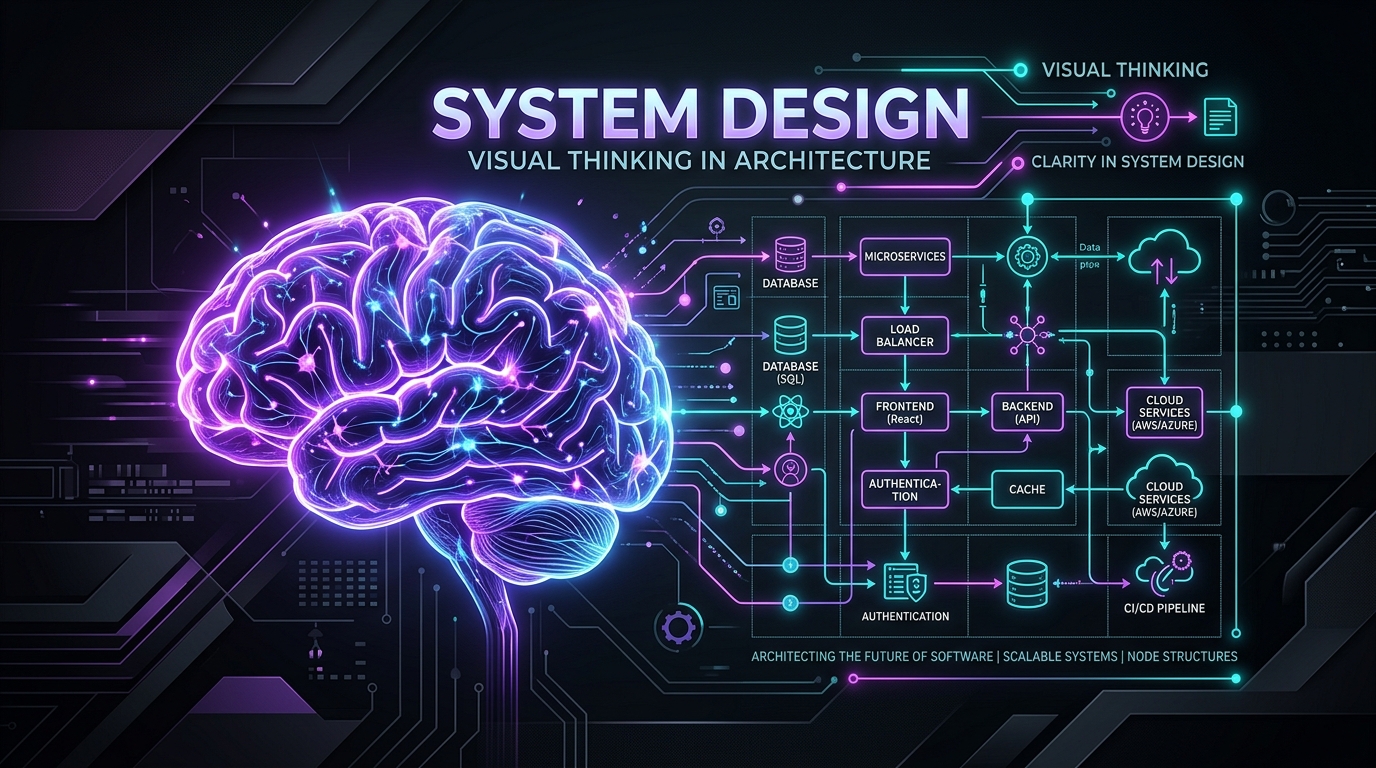
Software engineering is fundamentally about managing complexity. As developers, we build invisible, abstract structures that only exist in code. Without a way to visualize these structures, we are forced to hold the entire system in our working memory.
This is where visual thinking becomes a superpower.
The Cognitive Load Problem
Human working memory is limited. When we try to understand a complex system entirely by reading code or text, we quickly reach our cognitive limits. Visual models—like architecture diagrams, data flow charts, and entity-relationship diagrams—offload this mental effort to our visual processing system, which is incredibly powerful.
Diagrams as a Shared Language
Code is precise, but it's often too low-level for discussing high-level architecture. Text is ambiguous. Diagrams provide a middle ground.
When a team looks at a visual representation of a system, they immediately build a shared mental model. This prevents misunderstandings and aligns the team faster than any design document could.
Drawing to Design
Visual thinking isn't just for documentation; it's a critical part of the design process.
Before writing code for a complex feature, drawing the interactions can reveal edge cases, bottlenecks, and missing requirements. The act of drawing forces you to clarify your thoughts. If you can't draw the system clearly, you probably don't understand it well enough to build it.
At Rekhic, we believe that providing engineers with a seamless, infinite canvas tailored for software architecture is the best way to unlock this visual thinking potential.
The next time you're stuck on a complex problem, step away from the IDE and start drawing. You'll be surprised at how quickly the solution presents itself.